Speech to text
Stream a live transcript from the microphone, a file, a URL or raw PCM. Whisper base runs locally with automatic language detection.
Offline speech for the web and Node.js
Speech to text, text to speech and voice cloning in one typed package. Whisper and MOSS run locally, with no account and no cloud after setup.
MIT runtime · Apache-2.0 weights · WebAssembly SIMD
Every word stays on this device.
Capabilities
The same entry handles recognition and synthesis. Models download once, then every decode runs on the machine in front of you.
Stream a live transcript from the microphone, a file, a URL or raw PCM. Whisper base runs locally with automatic language detection.
Render two 48 kHz MOSS voices with pitch, rate, gain, temperature and seed controls. The text selects one of 20 languages.
Record three seconds, encode it with the MOSS tokenizer and reuse the codes as a speaking reference. No second recording needed.
A headless controller owns the worker, microphone capture, pause state and partial text. Bring your own markup and copy.
Accept 16 kHz PCM, a Blob or File, a URL, a Node filesystem path or the live microphone. WAV, FLAC and MP3 decode in Node.
Weights download once into IndexedDB or the disk cache. Resumable Range downloads, a 512 MB budget and no account.
How it works
One entry point chooses the right model, source and platform. The heavy work stays in WebAssembly on the CPU.
Microphone, PCM, Blob, URL or path. The first source present wins, so the same API fits a page, a worker or a Node script.
Whisper base streams through SIMD kernels with bounded memory, live partial text and decode timing measured over the model alone.
MOSS renders 48 kHz audio, optionally with a recorded reference and pitch, rate or gain changes applied after synthesis.
Live demo
Record, transcribe, speak and clone a voice. The first run downloads the model you pick.
Whisper base runs locally. The demo uses
Quality.Low, a 59 MB download on
first use. Record from the microphone.
Ready.
Pick an audio file and transcribe it with the same local Whisper base model. The first run downloads 59 MB.
Ready.
Pick a voice, tune the sliders and press Speak. The first run downloads the voice and keeps it cached. Pitch and rate apply after synthesis. Temperature and seed only affect the MOSS voices.
Ready.
Record a short reference from the microphone. Replay it in the player below. The first run downloads the 45 MB MOSS encoder. The recording joins the voice list as Cloned Voice, ready for the next Speak.
No reference recorded.
Case study
 DoListy
 is a to-do list with no signup and a
privacy-first design. It uses
@degreesign/voice for task dictation
and voice notes, so spoken tasks become text on the
device.
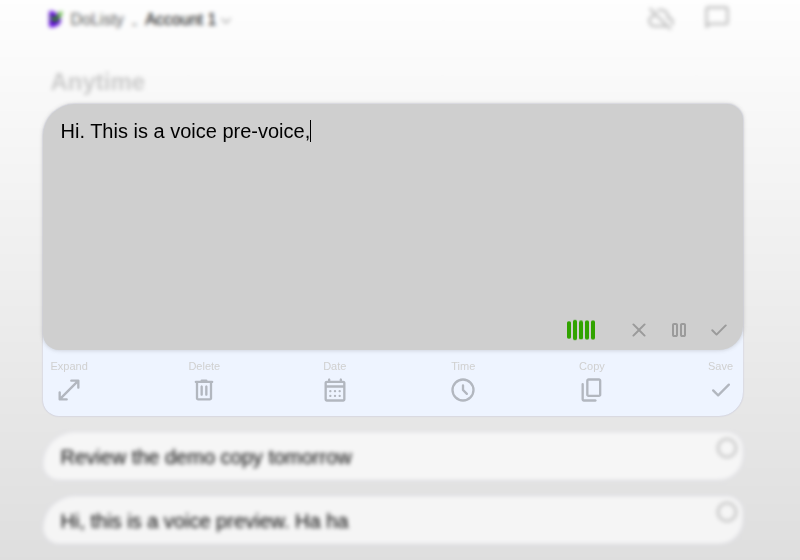
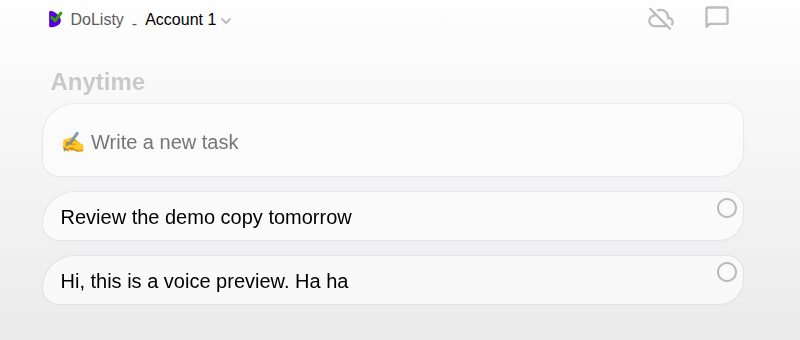
Screenshots from dolisty.com
Models
Pick a quality for the download you can afford. Quantized weights dequantize once, then share the same decode path.
| Quality | Weights | Size |
|---|---|---|
| High | F16 | 151 MB |
| Medium | Q8_0 | 85 MB |
| Low | Q4_K_M | 59 MB |
Multilingual by default. Set
Language.en for the English only
base.en checkpoint at the same sizes.
| Voice | Id | Output |
|---|---|---|
| Female | female |
48 kHz |
| Male | male |
48 kHz |
About 133 MB per voice. The clone encoder adds 45 MB and stays resident after the first use.
Architecture
Trace the package from the public entry through the model family, the tensor runtime, the platform stores and the audio input. The full map is one offline HTML file with a panel for following a call.
Opens in a new tab. One self-contained HTML file. Browse the source .
Install
One package for both directions. Node 24 or newer, or load the browser bundle straight from a CDN.
npm install @degreesign/voice
The dictation controller lives at
@degreesign/voice/dictation.
import {
    Language,
    transcribe,
} from "@degreesign/voice";

const session = transcribe({
    language: Language.auto,
});
const result = await session.done;

console.log(result.text, result.meta.rtf);